
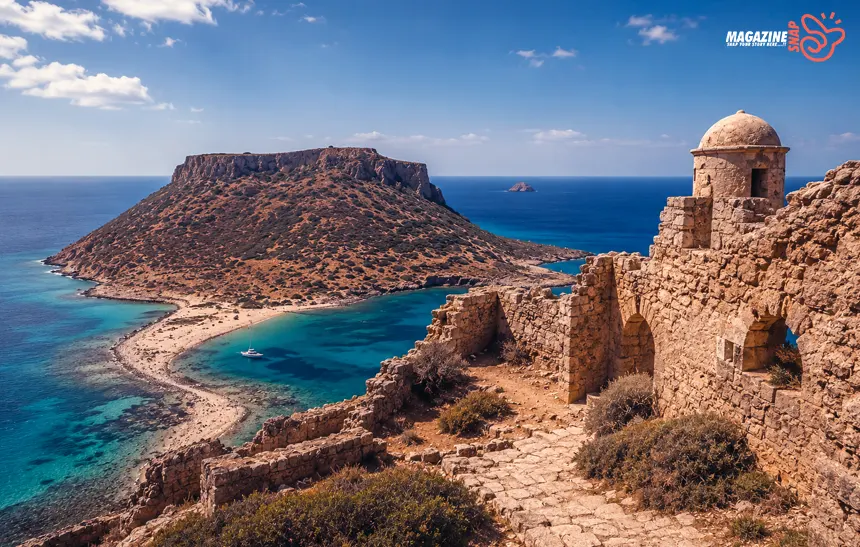
Most people who visit Crete end up at Balos. Pink sand, that famous turquoise water, the Instagram crowds. What they miss – usually because nobody mentions it – is a crumbling Venetian castle on a tiny wild island just offshore. A fort that ran pirate operations for years and was, for one brief strange moment, the first piece of Crete to shake off Ottoman rule.
That’s Gramvousa. If you like your travel with some actual story to it, this place earns a full day.
The Abandoned Pirate Fort Near Crete: Gramvousa Island
Gramvousa sits off the northwestern tip of Crete, close to the small town of Kissamos. There are technically two islands: Agria Gramvousa to the north – steep cliffs, howling wind, nobody goes there – and Imeri Gramvousa to the south, which is the one that matters.
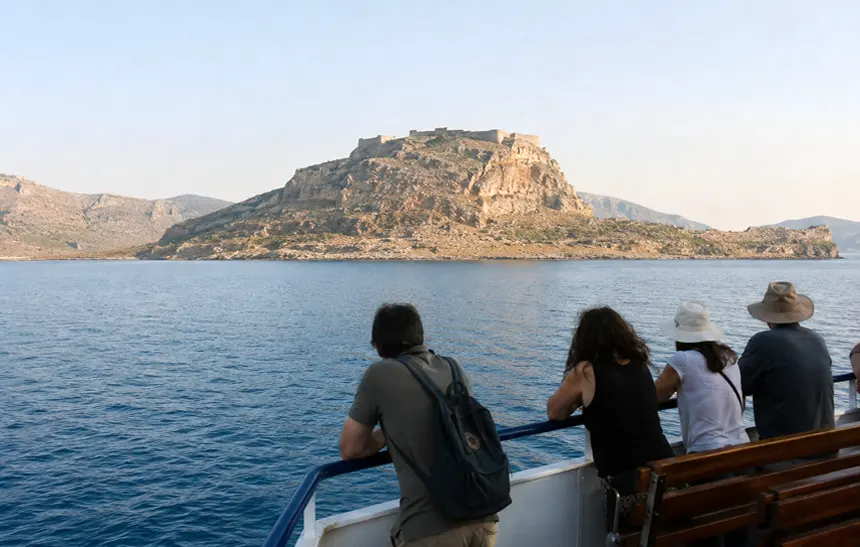
Small, uninhabited, genuinely wild. No cafes, no sunbeds, nothing. Just a beach, a half-submerged cargo wreck sitting on the shore like it gave up years ago, and a Venetian fortress clinging to a cliff 137 meters above the water.
You reach it by boat from Kissamos – about an hour out. The approach is part of the appeal. Dramatic coastline the whole way, and then the castle slowly materializes through the haze before you’ve fully processed that you’re almost there.
A History Worth Knowing
The Venetians built the Gramvousa fortress between 1579 and 1584. Defense against the Ottomans, mainly. It was massive – triangular, each side stretching over a kilometer, designed to hold 3,000 soldiers. Three stone lions, Venice’s emblem, carved into the walls.
For all that muscle, the Venetians never actually fought a battle here. In 1692, the fort simply changed hands when the Ottomans bribed the garrison commander – a Neapolitan captain who took the deal, handed over the keys, and lived out his days quite comfortably in Constantinople. History remembers him, without affection, as Captain Gramvousa.
The island drifted into half-forgotten no-man’s-land after that.
Then 1825 happened. A few hundred Cretan rebels – somewhere between 300 and 400 – pulled off a remarkable con. Disguised as Turks, they seized the fortress and turned it into a base for pirate operations across the Aegean. They weren’t picky about targets; Ottoman ships, yes, but also plenty of others. By 1828, a joint British and French fleet had dealt with the pirate fleet. A British frigate parked at the island afterward, just to make sure nobody tried to restart the whole business.
The fortress eventually went back to Ottoman control. But Gramvousa holds a particular place in Cretan memory – many consider it the first Cretan land freed from Ottoman rule, however briefly and chaotically that liberation played out.
One more detail worth knowing: there’s a church on the island. Dedicated to the Virgin Mary, though everyone calls it Panagia Kleftrina – roughly, the Thief Virgin. The pirates donated a tenth of whatever they’d plundered to her, apparently hoping she’d go easy on them for the other nine-tenths. Whether that counts as genuine devotion or spectacular audacity probably depends on your mood.
What You’ll See on the Island
The Venetian Castle
The whole reason you came. The path from the beach is rocky and steep – about 20 minutes up. In peak summer the midday heat makes it a proper ordeal. Not dangerous, just unpleasant. Go early.
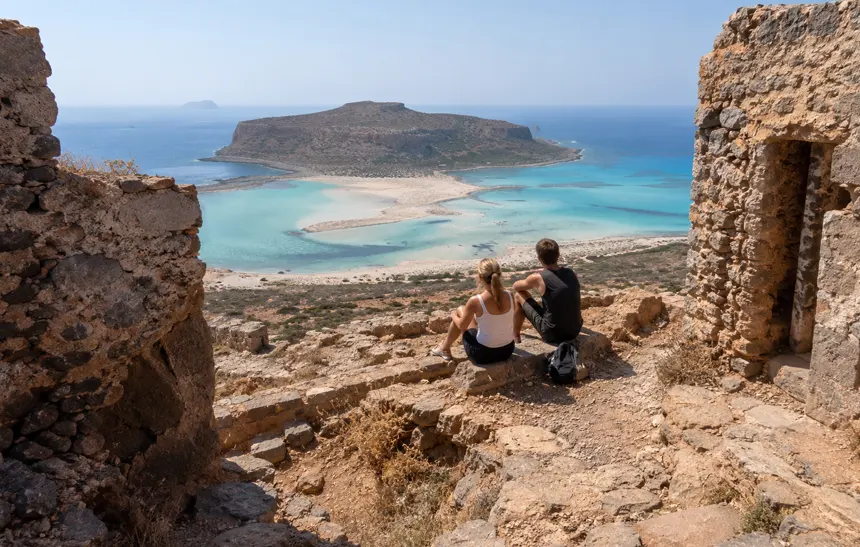
At the top, you get that view. The Aegean spreading in every direction, the protected Balos lagoon laid out below you, the kind of panorama that makes it immediately obvious why someone built a fortress here. The walls are still partly standing. Old cisterns. A defensive tower at the highest point. You can walk through most of it and get a real sense of the scale – it was enormous, and it still feels that way.
The Dimitrios Shipwreck
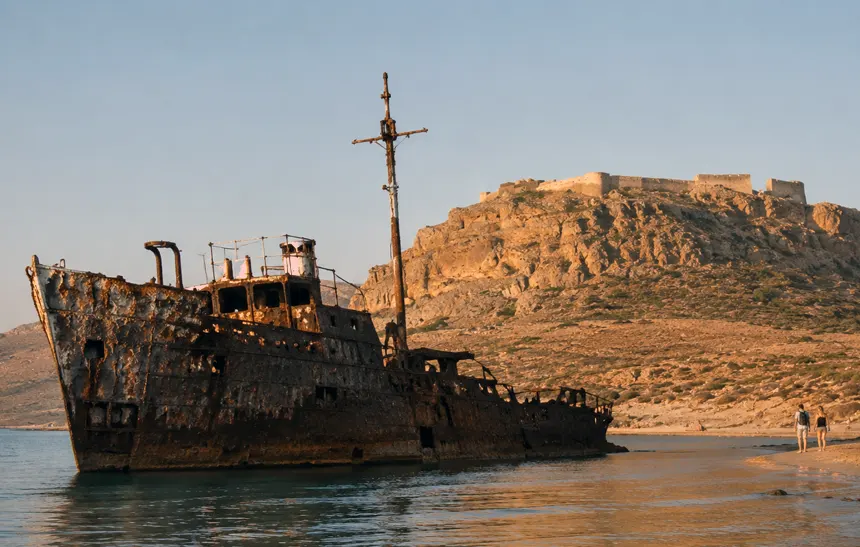
Right on the beach. A rusted cargo ship called the Dimitrios ran aground some decades back and never left. No diving gear required – you walk straight up to it. Photographically, it’s almost unfair: rust and salt and the castle looming above. Come at golden hour if your timing allows.
The Beach and the View South
The beach under the castle is shaded by tamarisk trees and has calm, clear water. It won’t compete with Balos for color, but it’s beautiful and less frantic. From a few spots on the upper path, you can look south and see the Balos lagoon stretching out below – that pale turquoise that looks slightly fake even when you’re staring right at it.
The Church of Panagia Kleftrina
Tucked into the fortress grounds, easy to walk past if you’re rushing back to the boat. Small, a bit worn. The story attached to it – pirates kneeling here with stolen goods, praying for moral latitude – is either charming or absurd. Probably both, honestly.

Things to Do at Gramvousa
Climb to the castle. Do it first, before the heat builds and before the second ferry unloads. The views are the payoff, but the ruins are worth exploring on their own terms.
Swim. The water is clear and genuinely calm. Most cruises pair Gramvousa with Balos on the same day, so you get several hours of swimming between the two stops.
Photograph the Dimitrios wreck. It photographs well from multiple angles – from the beach, from the path above, from the boat as you arrive. One of those spots that earns the camera time.
Snorkel. The waters around Gramvousa sit inside a protected marine zone. Mediterranean monk seals and Caretta caretta sea turtles are resident in the area. You won’t spot them on every visit, but marine life here is noticeably richer than at more crowded beaches.
Travel Guide: Getting to Gramvousa
From Kissamos Port
The standard approach. Cretan Daily Cruises and Blue Daily Cruises both run daily departures. An hour out, roughly 90 minutes on the island, then the boat continues to Balos before the return trip. A full day, done well.
From Chania
Chania is about 45 km from Kissamos. Several operators sell combined bus-and-boat packages – a coach picks you up, drives to the port, boat ticket included. The whole excursion takes 6 to 7 hours. Practical if you’re based in Chania and don’t want to sort out your own transport.
From Falasarna Port
Worth knowing about, and often overlooked. Some semi-private tours depart from Falasarna, which sits closer to the island. Boats cap at 49 passengers, so it’s noticeably quieter than the main ferry. The approach angle to the island is different too.
Best Time to Visit
Boats run April through October. May, June, and September are the obvious sweet spots – warm, water swimmable, crowds at a level that doesn’t wreck the atmosphere. July and August are full peak season: boats fill days in advance, the castle hike at midday becomes genuinely punishing, and Balos gets extremely crowded.
Going in summer? Take a morning departure. Better light, cooler conditions for the hike, and you’ll be ahead of the afternoon rush by several hours.
Budget Breakdown
The standard Kissamos ferry for the Gramvousa and Balos combined cruise runs €40-45 per adult in 2026. The €40 price applies April through mid-July and again from mid-September through October; peak summer bumps it to €45. Kids aged 3-12 pay €24-27. There’s also a €1 per person nature tax for Balos, collected at boarding.
Bus transfer from Chania plus boat ticket as a package comes to about €53 per person.
Semi-private tours from Falasarna run around €60 per person. Full private charters start from €380 – which splits reasonably across a group of six or more if you want flexibility and fewer people around you.

One practical note: book directly with Cretan Daily Cruises or Blue Daily Cruises if you can. The prices are the same as third-party platforms, but you skip the booking fees.
Expert Tips for Visiting
Climb first, swim later. When the boat lands, everyone heads to the beach. Do the opposite. Go up while you’re fresh and the island is still cool. For about 20 minutes, the ruins are yours.
Carry more water than seems reasonable. Nothing to buy on the island. A liter per person covers the hike; in summer heat, 1.5 liters is the smarter choice.
Footwear matters more than you’d think. Flip-flops on that rocky path are a mistake. Trainers or sandals with actual grip. The path is uneven and exposed the entire way up.
Book summer ferries ahead. June through August, boats fill up several days in advance. May and late September are far more forgiving – walk-up tickets are usually available, especially on weekdays.
Consider the Falasarna departure. If the main ferry sounds like too much, it genuinely is a different experience. Fewer people, more room, a quieter island when you arrive.
Don’t walk past the shipwreck. It’s easy to spend all your time at the castle and sprint back to the boat. The Dimitrios takes 10 minutes to walk around. Spend them.
FAQs
Is Gramvousa the abandoned pirate fort near Crete?
Yes. Imeri Gramvousa is home to a Venetian fortress that became a pirate base in the early 1800s during the Greek War of Independence. It’s the most well-known pirate-history site in Crete, and arguably in the wider Aegean.
Can you visit the Gramvousa castle for free?
The island charges no entry fee. You pay for the boat to get there; once you land, the castle is free to explore.
How long does the climb take?
About 20 minutes from the beach. Steep, rocky, and exposed. Most people in reasonable shape handle it fine – just not in sandals, and not at noon in August.
Does anyone live on Gramvousa?
Nobody. Completely uninhabited. No residents, no hotels, no services. It’s a protected natural and historical site.
What’s the deal with the shipwreck?
The Dimitrios – a small cargo vessel – ran aground on the beach some decades ago and was never removed. It sits right at the waterline. No gear needed; you walk straight to it.
Is it worth visiting Gramvousa without Balos?
Yes, particularly if history and ruins interest you more than beach time. Balos is spectacular but also extremely crowded in season. Gramvousa has a completely different energy. If you can only choose one: see both. But Gramvousa holds up entirely on its own.
When do boats run to Gramvousa?
April through October, with daily departures from Kissamos during the main season. Confirm current schedules directly with Cretan Daily Cruises or Blue Daily Cruises before booking.
Why Gramvousa Stays With You
Greece has no shortage of pretty islands. What Gramvousa has that most of them don’t is texture – the kind built from centuries of actual events rather than careful restoration.
The castle is crumbling. The church still carries a thief’s name. The Venetian stone lions on the walls are worn so smooth you have to look twice to make them out. A rusted ship has been sitting on the beach long enough to become a landmark. None of it has been tidied up or explained into something comfortable.
It just sits there, daring you to piece it together yourself.

Other Articles