

There’s a specific kind of frustration that comes from studying hard and still failing. You put in the hours. You read the chapter twice. You showed up, and the test still went badly.
Re-reading and highlighting, the two things most struggling students default to, are among the weakest study methods we know of. A 2013 review in Psychological Science in the Public Interest ranked re-reading near the bottom of effective learning strategies. Students keep using it anyway because it feels productive. Feeling productive and actually encoding information are not the same thing, and the gap between them is where most academic failure lives.
This guide is for students who’ve been told to “study more” and found that advice useless.
- Why "Trying Harder" Keeps Failing You
- What the Research Actually Says About Study Methods
- Study Tips for Weak Students: Start Here
- The Sleep Variable Most Students Ignore
- Common Mistakes That Keep Students Stuck
- How Teachers Actually See Struggling Students
- What Actually Improves, and When
- FAQ: Study Tips for Weak Students
Why “Trying Harder” Keeps Failing You
Picture the cycle: bad grade, guilt, three hours at a desk, marginal improvement, repeat. Most students stuck here aren’t failing because of low intelligence. Passive study methods just don’t build lasting memory. Sitting with a highlighter is not studying; it’s reading with extra steps.
The cognitive science term for what’s happening is “the illusion of knowing.” You read something, it feels familiar, and your brain registers that familiarity as understanding. Familiarity and recall are entirely different processes, though, and the exam tests the second one. You can recognize a word in a textbook and blank on it completely in a test because recognition doesn’t require the same retrieval pathway.
What’s striking here is how consistent this finding is across age groups and subjects. Weak students almost universally study in a way that generates familiarity without building retrieval. That’s the core issue, and once you see it, the fix becomes obvious.

What the Research Actually Says About Study Methods
The most rigorous comparison we have comes from a meta-analysis by Dunlosky et al., published in Psychological Science in the Public Interest, which rated 10 common study methods on their evidence base. Two came out clearly on top: practice testing (active recall) and distributed practice (spaced repetition). Re-reading and highlighting ranked near the bottom.
Students using active recall retain significantly more material after one week than students who re-read the same content. The researchers found this held across subjects, age groups, and academic levels, which is not something you often see in educational research. Most findings are messier and context-dependent.
Most struggling students have never been explicitly taught either technique. They cobble together habits from watching classmates or following instinct, and both tend toward passive review.
Study Tips for Weak Students: Start Here
Work in 25-Minute Blocks, Not 2-Hour Marathons
Your working memory holds focused attention for roughly 20 to 30 minutes before performance starts to drop. Two hours straight doesn’t double your output; it gives you maybe 45 productive minutes buried in an hour of mental drift. I’ve noticed students consistently overestimate how much actual work happens in long sessions, partly because time spent feels like progress.
The Pomodoro technique maps almost exactly to how attention works: 25 minutes of focused work, a 5-minute break, repeat four times, then a 20-minute rest. The timer matters more than people expect. Working without one lets you negotiate with yourself mid-session. Set it, commit, and let the clock do the discipline.
One specific note: put your phone in a different room. A 2017 study from the University of Texas found that the mere presence of a smartphone on a desk reduces available cognitive capacity, even when the phone is face-down and silent. A different room, not a different pocket.
Find the Gap Before You Move Forward
Most students struggling with a current topic are missing something from 2 or 3 topics back. Algebra confusion often traces to fraction operations. Essay problems often come down to not understanding sentence structure at the clause level.
Khan Academy is genuinely good for this, and I don’t say that about many free tools. Search the topic you’re stuck on, look at the prerequisite lessons, and work backward until you find the point where things still made sense. Spending 3 days filling a foundational gap will save weeks of confusion later. Most students skip this step because it feels like going backward, but it’s usually the fastest path to catching up.
Use Active Recall After Every Session
Close your notes. Open a blank page. Write down everything you remember from what you just studied.
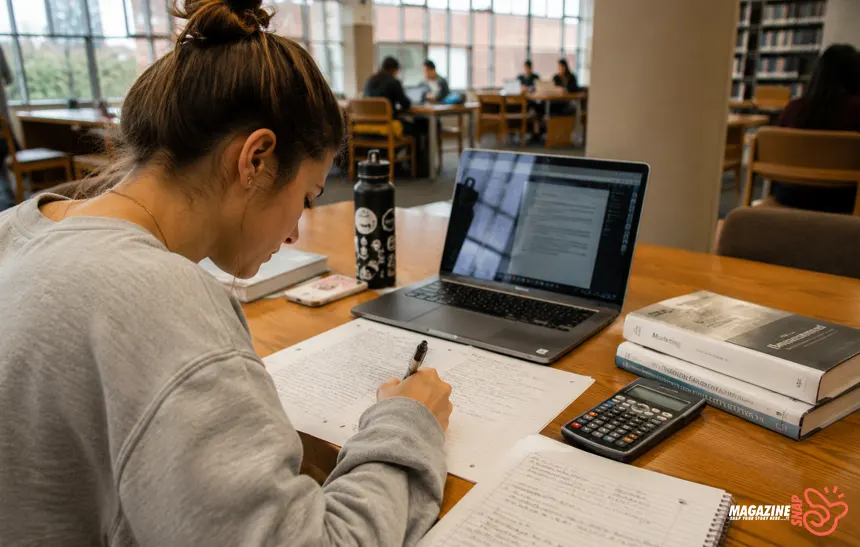
You’ll miss things. That discomfort is the learning happening, not a sign that the method isn’t working. The effort of retrieval, not the act of reading, is what builds durable memory. Cognitive psychologists call this the “testing effect,” and it’s among the most replicated findings in educational research. After each session, spend 5 minutes writing a summary in your own words, then check what you missed and add it.
Space Your Review Sessions Out
Hermann Ebbinghaus, who studied memory in the 1880s, found that roughly 50% of new information fades within 24 hours without review. His forgetting curve research still holds up, which is either reassuring or alarming depending on how you look at it.

Spaced repetition works by reviewing material at increasing intervals: day 1, day 2, day 5, day 14. The spacing grows as the material sticks. Anki automates this; you create flashcards, flag the ones you miss, and the app schedules them more frequently until they stick. Students who use spaced repetition consistently retain significantly more over the long term than those who study the same content in a single block. If you’ve ever crammed for a test and remembered nothing a week later, the forgetting curve is why.
Study With One Person Who’s Slightly Ahead of You
A study group where everyone is equally lost doesn’t help anyone. Find one person who understands the material a bit better than you and explain what you learned to them, even if they already know it.
Teaching forces you to organize your thinking. When you can’t explain something clearly, that confusion exposes exactly where your understanding breaks down. Researchers call this the protégé effect: you learn more when you’re trying to teach than when you’re trying to absorb. Even explaining to a parent who knows nothing about the subject works. The act of simplifying forces you to actually understand it first.
The Sleep Variable Most Students Ignore
Every technique in this guide loses most of its power if you’re sleeping 5 hours a night. Memory consolidation happens during slow-wave sleep; your brain literally replays what you learned and moves it from short-term to long-term storage. Research from the University of California has shown that sleep deprivation impairs this process measurably.
A student who sleeps 8 hours after a study session typically outperforms one who sleeps 5 and studies twice as long. Fix your sleep before you fix your schedule. It sounds like the kind of advice you’d ignore, but the neuroscience behind it is solid.

Common Mistakes That Keep Students Stuck
Highlighting everything. When everything is marked, nothing is. Highlighting creates the feeling of engagement without the cognitive work of actual thinking. The result: colorful textbooks, poor test scores.
Tackling easy material first. Starting with what you already know feels productive. You’re also burning your sharpest cognitive hours on content that didn’t need them. Do the hardest material first.
Studying once and moving on. One good session accomplishes very little without follow-up. Memory fades without spaced review, and a single sitting almost never produces lasting retention.
Comparing your pace to other students. You’re working from a different starting point. Measuring against someone else’s progress adds anxiety without adding information. Measure against yourself: what do you understand today that confused you yesterday?
How Teachers Actually See Struggling Students
Most struggling students avoid their teachers out of embarrassment. Understandable. But teachers generally respond well to students who show specific effort and ask concrete questions.
“I’m lost” is genuinely hard to answer. “I understand the formula but I can’t apply it when there are 2 unknowns” is actionable. The more specific your question, the more useful the answer you get. Teachers also notice who asks. That visibility matters, particularly when grade decisions are close.
Go before class, go after class, or email with a specific question. It changes how a teacher sees your effort, which sometimes matters as much as the work itself.
What Actually Improves, and When
Short-term, most students using active recall consistently notice better quiz results within 3 to 4 weeks. Confidence in class tends to come before grades do, which matters more than it sounds: low confidence keeps students from participating, and participation actually accelerates learning by creating another retrieval opportunity.
Long-term, the habits outlast the subject. A student who learns how to learn has a compounding advantage. The 2024 LinkedIn Workplace Learning Report listed adaptability and self-directed learning among the top traits employers look for, above many technical qualifications. Building this skill during school isn’t just about GPA. It’s about having the capacity to pick up new knowledge quickly, which is useful in almost every field.
FAQ: Study Tips for Weak Students
How long does it take to see real improvement?
Most students using active recall and spaced repetition consistently notice change within 4 to 6 weeks. Full grade improvement tends to show up within one term. The techniques work faster than most students expect; the hard part is consistency in the early weeks before results are visible.
Can a struggling student realistically become a strong one?
Yes, and more often than people assume. The gap between weak and strong students is usually method and consistency over time. Most high-performing students have found systems that work with how memory functions, not higher raw intelligence.
What’s the single most effective technique for a student who’s behind?
Active recall, specifically closing your notes and testing yourself from memory, beats everything else for retention. It’s uncomfortable at first, and that discomfort is exactly why it works.
Is it better to study daily or just before tests?
Daily short sessions beat sporadic long ones. Even 20 minutes of focused review keeps material accessible. Cramming produces short-term recognition but almost no durable retention.
How do you stay motivated when progress feels slow?
Track small, specific wins. Write down one thing you understood today that confused you yesterday. Progress at this level is more motivating than waiting for a grade. Connect the subject to something real when you can; even a loose connection makes material feel less arbitrary and easier to retain.