
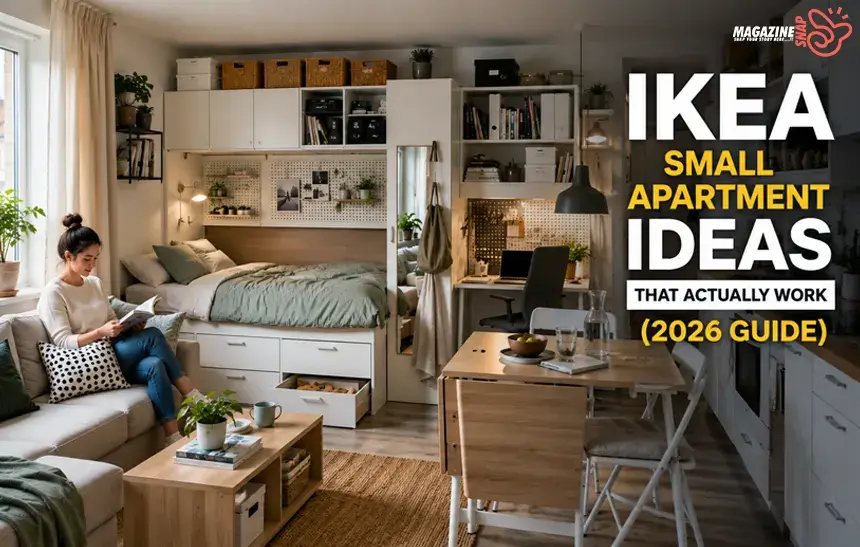
You move into a 400-square-foot flat and spend the first two weeks convinced it’ll be fine. Then you unpack your stuff and realize your sofa takes up more floor space than your kitchen. Your wardrobe doors swing into your bed. You have nowhere to put your shoes, your laptop, or that pile of things you’ve been meaning to deal with since Tuesday.
Most apartment ideas online are written by people who’ve never actually lived in a tiny studio. They tell you to “use vertical space” and call it advice. This article is for the rest of us – people who have genuinely had to figure out where to eat, sleep, work, and store winter coats in the same 35 square meters.
IKEA is where most of us end up, sooner or later. It’s budget-friendly, it’s everywhere (IKEA UK, IKEA Australia, most of Europe), and their designers actually think about small spaces. Not always perfectly – but enough that they’ve become the default starting point for anyone furnishing a compact flat.
Here’s what works, what doesn’t, and what I wish someone had told me before I assembled the wrong things in the wrong order.
- The Mindset Shift You Need First
- IKEA Small Apartment Ideas That Hold Up
- Setting Up Zones in a Studio Apartment
- The Kitchen: Where Small Apartments Get Brutal
- Lighting, Textiles, and Making It Feel Like Home
- Storage Ideas That Actually Work for Renters
- Mistakes People Make (Including Me)
- A Quick Note on the IKEA Ecosystem
- FAQ
The Mindset Shift You Need First
Before you buy anything, there’s a more useful question than “what furniture should I get?” The better question is: what do you actually use daily?
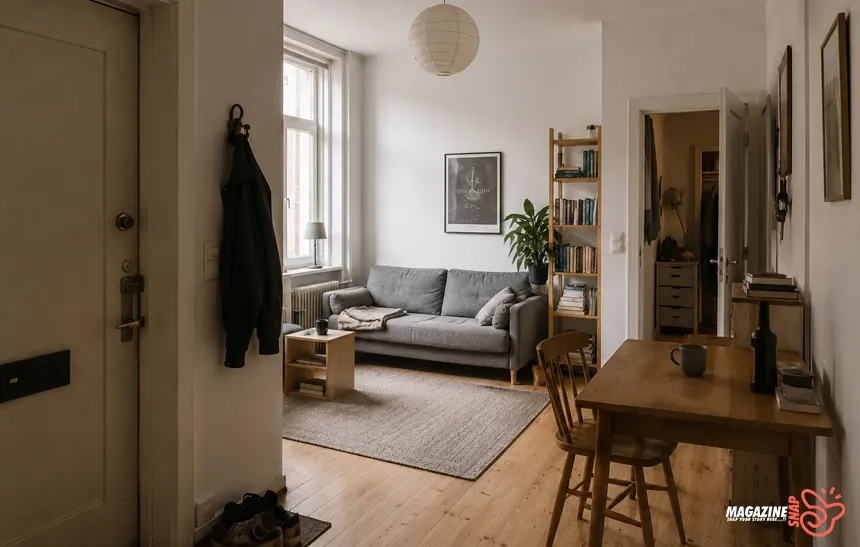
Most people overfurnish small apartments because they’re replicating the layout of a bigger place they used to live in. You don’t need a 3-seater sofa if you live alone. You probably don’t need a dining table that seats 6 if you eat alone 90% of the time. Getting honest about things you don’t need – or more specifically, things you don’t need daily – clears the mental space to make smarter choices.
When a friend moved from a 2-bedroom house into a city apartment, she spent the first month tripping over a bookcase, a side table, and a TV unit she’d kept “just in case.” Eventually she stripped it back. The apartment felt twice as big with half the furniture.
Store things you don’t need in the highest shelves, under the bed, in vacuum bags in the wardrobe. Create room for how you actually live, not how you imagine you might live.
IKEA Small Apartment Ideas That Hold Up
The KALLAX Is the Most Useful Thing They Sell
Seriously. The KALLAX shelving unit = available in 2×2, 4×2, 5×5 configurations = is probably the most thought-through product for compact living that IKEA makes. It works as a room divider in an open plan space. It holds books and plants on the open shelves while the inserts with doors (sold separately) act as hidden storage for anything you don’t want on display.
The 2×4 KALLAX placed horizontally becomes a media unit, a low cabinet, a worktop for a makeshift bar. At roughly 77cm tall, it doesn’t eat the wall visually the way a tall unit does.
The honest tradeoff: assembly is annoying, the connectors strip if you rush, and the internal shelves flex under heavy loads. Don’t put 20kg of textbooks on one shelf and expect it to stay level.
RÅSKOG Trolley: Ugly Name, Brilliant Object
The RÅSKOG trolley with wheels is one of those things that doesn’t look like much in the store but transforms a small kitchen. You wheel it under a counter when you need to. You wheel it next to you when you’re cooking. In a small kitchen with about 60cm of counter space (a real number in London flats, not a hypothetical), having a trolley that moves is the difference between functional and chaotic.
It’s also useful as a bathroom storage unit, a bedside table that slides out of the way, or an office supply station next to your desk.
BILLY for a Living Area: Good, With Caveats
The BILLY bookcase is as close to a design classic as flat-pack gets. It’s thin-profiled, vertical, and affordable. In a living space with high ceilings, a row of BILLYs with the glass-door attachments looks genuinely good – almost like built-ins if you add cornicing.
The caveat: BILLY without the door attachments is purely open shelves, which looks great in theory but becomes a dusting nightmare in practice. Every exposed shelf in a small apartment collects clutter because you’re always 2 steps away from putting something down somewhere. Adding the doors fixes this. A mix of open and closed storage – some shelves open for plants and books, some with doors for the stuff you don’t want to look at – works better than going fully open or fully closed.
HEMNES: Worth the Extra Weight
HEMNES is IKEA’s solid wood range. Heavier to assemble, harder to move, but it looks substantially better than particleboard once it’s up. The HEMNES dresser in particular works in a tiny studio or little studio apartment because the proportions are considered – narrow depth (about 50cm), decent height, and a surface you can actually use as a vanity or landing zone.
The downside is obvious: weight. If you’re a renter who moves every 2 years, HEMNES is less appealing because dismantling and reassembling solid wood furniture is genuinely miserable. The drawer-bottom panels warp if you’re not careful. But if you’re settling somewhere for 3+ years, it’s worth it over MALM.
MULIG or BOAXEL for Wardrobes
Renters often can’t modify the built-in storage they inherit. MULIG clothes rails are freestanding, cheap, and take 15 minutes to set up. Not the most beautiful thing, but they work. BOAXEL is IKEA’s modular wall storage system – more considered than ALGOT was, better-looking – and it can be installed without major wall damage if you use appropriate fixings.
One honest note here: altering or modifying IKEA products to fit specific renter spaces (cutting shelves down, drilling different holes) is technically possible but only worth doing if you’re confident with tools. The particleboard doesn’t forgive mistakes.
Setting Up Zones in a Studio Apartment
A studio apartment without zones feels like one big room where you can’t mentally switch off. The fix isn’t building walls – it’s using furniture to imply boundaries.
The KALLAX (again) placed perpendicular to a wall creates a partial divider between your sleeping area and your living room without blocking light. A rug under your sofa area defines the zone further. Lighting does a lot of work here too: a floor lamp in the sleeping corner signals “this is a different space” in a way that overhead lighting can’t.
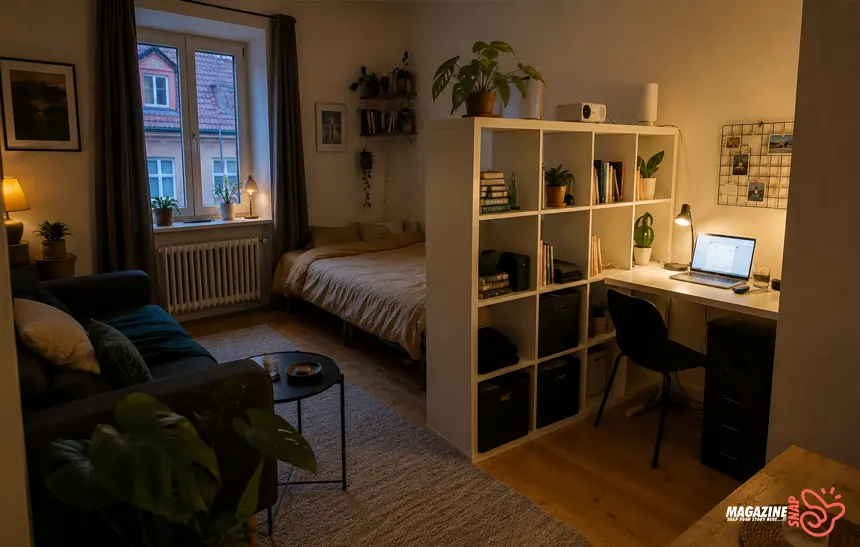
The workspace problem deserves its own mention. If your living room is a workspace – which it is for most people working from home in compact flats – you need the visual “off switch” at the end of the day. The MICKE desk folds against a wall in some configurations. A KALLAX row behind your chair with a curtain rail across it lets you close off the “office” side with a textile panel. It sounds fiddly; in practice it genuinely helps.
For a home office setup in a small footprint, the ALEX drawer unit under a LINNMON tabletop gives you ample storage without taking up a whole room. The LINNMON is cheap and replaceable. Don’t overthink it.
The Kitchen: Where Small Apartments Get Brutal
A small kitchen in a rented flat usually means: limited counter space, minimal drawer depth, and cabinets positioned by someone who didn’t cook. IKEA products help here more than most people expect.
The GRUNDTAL magnetic knife strip saves an entire drawer. The SKÅDIS pegboard (originally for offices) works on a kitchen wall for utensils, cutting boards, and the miscellaneous stuff that otherwise ends up in a junk drawer. The VARIERA shelf inserts double the vertical storage inside existing cupboards – a genuinely useful £5 fix.
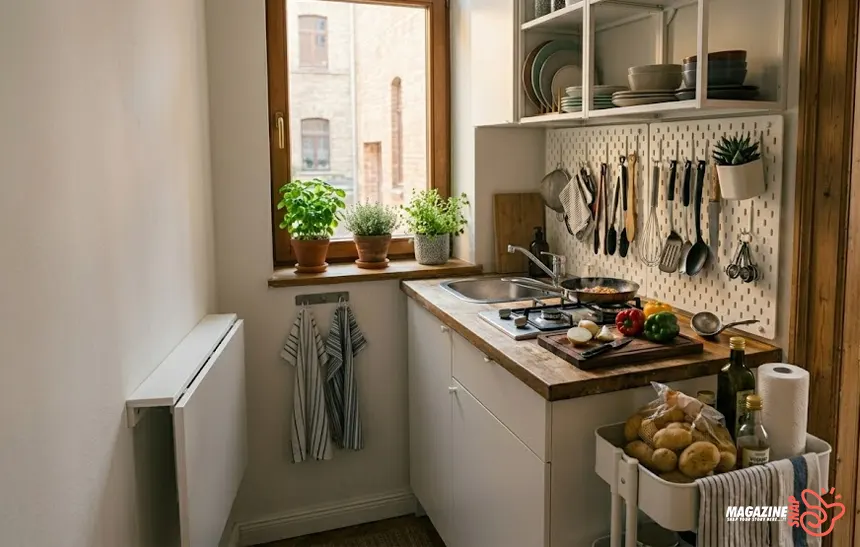
The kitchen table situation: if you eat at a table at all, look at the NORDEN gateleg or the NORBERG wall-mounted option. The kitchen table is foldable in both cases. NORBERG folds completely flat when you’re not using it – ideal for a space where the dining table doubles as a place to work and you need to reclaim the floor when you’re done.
Lighting, Textiles, and Making It Feel Like Home
This section gets skipped in most small-space living guides, which is a mistake. A cosy apartment and a cramped apartment can have identical floor plans. The difference is almost entirely in light and textile layers.
IKEA’s SYMFONISK speakers double as shelf units. Their TERTIAL work lamp is better than most dedicated desk lights at 3x the price. RANARP wall lamps save bedside table space.
For textiles: a heavier curtain in a darker shade makes a bedroom corner feel contained in a good way. A light rug in the living area (STOENSE or GRÖNSKÄR) makes the floor feel bigger by giving it a defined boundary. Cushion covers on a sofa go a long way toward personal style – they’re cheap, replaceable, and you can change them seasonally without committing.
The instinct in small apartments is to go all-white-everything to make it feel bigger. This works to a point, then it starts feeling clinical. A confident colour on one wall (or just in your textile choices) actually helps the space feel more resolved, like someone made deliberate decisions here.
Storage Ideas That Actually Work for Renters
Clever storage in a rented apartment means: no permanent modification, nothing that leaves damage, and ideally easy to dismantle on moving day.
Under-bed storage is the most underused space saving option in small apartments. IKEA sells the SULTAN LADE (a slatted bed with drawers underneath) but honestly, standalone under-bed boxes – the SKUBB flat storage bags work well – are more flexible and easier to take with you.
The RÅSKOG trolley (yes, again) earns its place as extra storage in a bathroom, between the washer and wall, or next to a wardrobe.
SKÅDIS pegboards on bedroom walls hold jewellery, scarves, bags – things that traditionally end up piled on a chair.
LACK side tables stacked or used as risers create cheap display and storage spots. Ugly on their own; surprisingly functional in context.
The thing about open and closed shelves in a small apartment: open looks better in photos, closed works better in life. When you’re tired and busy, open shelves become a visible record of how behind you are on tidying. A closed cabinet hides all that. Smart storage means being honest about your actual tidiness habits.
Mistakes People Make (Including Me)
Buying too much at once. You tour an IKEA showroom and everything looks manageable at scale. In a 35m² apartment, 6 pieces of flat-pack furniture is a lot. Start with the pieces you need to function and add slowly.
Getting a sofa that’s too deep. The depth of a sofa matters more than the width in a small apartment. A 100cm-deep sofa eats the room. The SÖDERHAMN is modular and lighter-looking. The KIVIK has a shallower option. Measure twice.
Ignoring wall space. Most people focus on floor furniture and ignore the walls. IKEA’s SKÅDIS, BJÖRKSNÄS shelving, and BYGEL rails are all space-activating solutions that move storage off the floor.
Not planning for cables. Every desk setup, every TV, every lamp creates cable mess. In a small apartment there’s nowhere to hide it. A SIGNUM cable management rail under the desk takes 20 minutes to install and removes a genuinely irritating visual problem.
Buying the wrong height. A tall cabinet in a low-ceilinged apartment makes the room feel like a box. A 2m-high PAX wardrobe in a 2.4m ceiling room is fine. In a 2.2m ceiling space it feels oppressive. Measure before you buy.
A Quick Note on the IKEA Ecosystem
Whether you’re shopping at IKEA UK, working through the IKEA Australia website, or just browsing the app, the room planner tool is genuinely useful before you buy. It’s not perfect – it’s clunky and occasionally crashes – but dropping your actual apartment dimensions into it and testing configurations saves real money and real frustration.
Some people hire an IKEA interior designer for a planning session. The service varies in quality, but if you’re furnishing an entire studio apartment from scratch, a 1-hour session with someone who knows the range well can save you from obvious mistakes. The sessions at most UK stores are free or low-cost and worth booking.
The small and smart range label IKEA uses for compact-living-specific products is a decent filter when you’re overwhelmed. It’s not exhaustive – plenty of their standard range works well in small spaces – but it’s a reasonable starting point when you don’t know where to begin.
FAQ
Can IKEA furniture make a tiny apartment feel bigger?
Partially. Lighter-coloured furniture and pieces with legs (like the LISABO table or the EKET cabinets mounted above the floor) create a sense of openness. But no furniture arrangement replaces decluttering. Getting rid of things you don’t need daily matters more than any single furniture choice.
What’s the best IKEA piece for multifunctional use?
Honestly, the KALLAX unit. It’s a room divider, a bookcase, a TV unit, a cabinet, and sometimes a bench if you add a cushion on top. The multipurpose flexibility is real. Second choice: the RÅSKOG trolley.
Is it worth paying for IKEA’s assembly service?
In a tiny apartment, yes – particularly for large PAX wardrobes or bed frames. There’s no room to lay out all the pieces, which makes assembly harder and slower. The cost is usually £60-£100 for a wardrobe; weigh that against 3 hours of frustration in a cramped space.
How do I stop a small apartment from feeling cluttered?
Buy less. Use boxes inside cabinets so that even “messy” storage has a container. Add one plant. And accept that some weeks it will look cluttered because you’re busy – that’s fine. Creating a home takes iteration, not perfection.
IKEA or second-hand for a small apartment?
A mix. IKEA for structural pieces (bed frames, wardrobes, shelving). Second-hand for the things that add personality and visual interest: a vintage armchair, a better rug, ceramic pieces. IKEA’s strength is function; second-hand’s strength is character. Both together are better than either alone.