
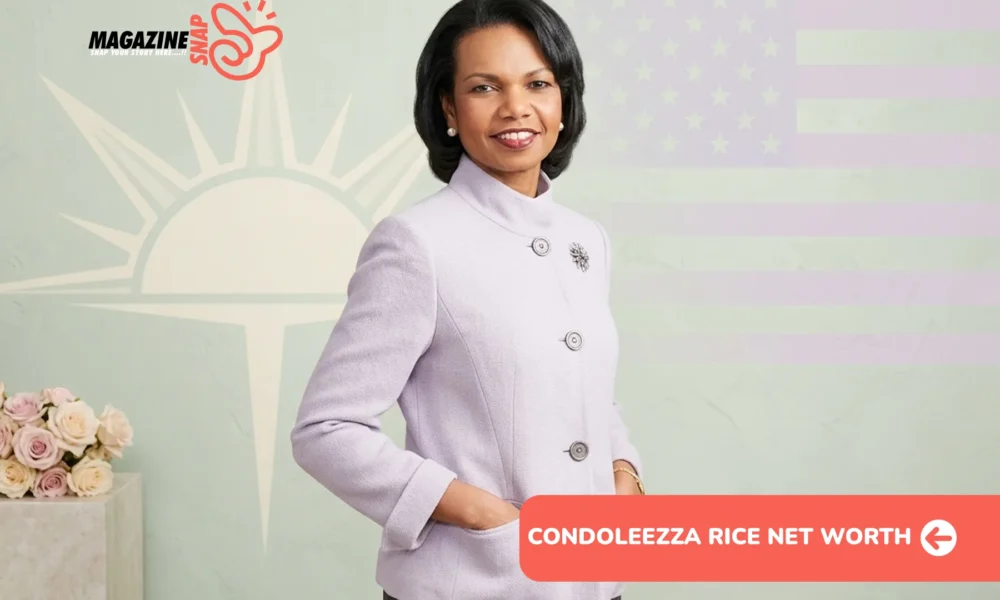
Condoleezza Rice’s 2026 net worth falls somewhere between $12 million and $30 million, built on her Stanford salary, board pay, book royalties, and speaking fees. Published figures vary because Rice has never disclosed a full personal balance sheet.
- Condoleezza Rice's Quick Facts and Career Snapshot
- From Birmingham to Stanford University
- National Security Advisor and Secretary of State Years
- How Condoleezza Rice Built Her Wealth After Government
- Net Worth Methodology: Reading Rice's Public Career Income
- Net Worth Breakdown Table
- Is Condoleezza Rice a Millionaire?
- Where Rice Stands Among Former Cabinet Officials
- Personal Life and Public Roles Beyond Politics
- Condoleezza Rice's Financial Legacy Beyond the Numbers
- Editorial Note
- Frequently Asked Questions
Condoleezza Rice’s Quick Facts and Career Snapshot
| Category | Detail |
|---|---|
| Full Name | Condoleezza Rice |
| Known As | Condi Rice |
| Date of Birth | November 14, 1954 |
| Age | 71 (as of 2026) |
| Birthplace | Birmingham, Alabama |
| Nationality | American |
| Profession | Political scientist, diplomat, professor, author |
| Years Active | 1981 to present |
| Marital Status | Never married |
| Children | None publicly known |
| Famous For | Serving as U.S. Secretary of State and National Security Advisor |
| Estimated Net Worth | $12 million to $30 million |
| Main Income Sources | Stanford University salary, corporate board pay, book royalties, speaking fees |
From Birmingham to Stanford University
Rice was born on November 14, 1954, in Birmingham, Alabama, the only child of John Wesley Rice Jr. and Angelena Rice. Her father worked as a minister and dean of students, and her mother taught high school. The family later moved to Denver, Colorado, where Rice attended St. Mary’s Academy.
She graduated from the University of Denver at age 19 with a bachelor’s degree in political science. Rice then earned a master’s degree from the University of Notre Dame in 1975, and she returned to the University of Denver for a doctorate in international studies in 1981. That same year, Stanford University hired her as an assistant professor of political science, a role that launched her lifelong connection to the school.
Rice specialized in Soviet and East European affairs during the Cold War years, and Stanford promoted her to provost in 1993. She held that post until 1999, overseeing the university’s budget and academic direction before her move into national politics.
National Security Advisor and Secretary of State Years
President George W. Bush named Rice as national security advisor in 2001, making her the first woman to hold that role. She served on the National Security Council through some of the most tense years in recent American foreign policy, including the response to the September 11 attacks.
In 2005, Bush appointed Rice as secretary of state, and she held the post until 2009. She became the first African American woman to serve as secretary of state, following Colin Powell as the second Black secretary of state overall. Her work focused heavily on foreign policy in the Middle East and broader efforts to promote democracy abroad.
Federal pay scales set cabinet salaries, and those scales run well below private sector pay. Rice’s earnings during this period came mainly from her federal salary rather than any outside business income, since cabinet officials face strict rules on outside earnings while serving.
How Condoleezza Rice Built Her Wealth After Government
Rice returned to Stanford in 2009 as a professor of political science and a senior fellow at the Hoover Institution. Stanford named her the Denning Professor in Global Business and the Economy at the Graduate School of Business, and she became the eighth director of the Hoover Institution in 2020.
She also co-founded RiceHadleyGates, an international strategic consulting firm that advises companies on political risk and global markets. This kind of consulting work pays well because clients want direct access to a former secretary of state’s network and judgment.

Rice has sat on several corporate boards over the years, including Dropbox and C3.ai, and earlier in her career she served on the boards of Chevron Corporation, Hewlett-Packard, and Transamerica. Board seats typically pay a mix of cash retainers and stock grants, and SEC filings show Rice holding tens of thousands of shares in companies like Dropbox and C3.ai. She has also written several books, including “Extraordinary, Ordinary People,” “No Higher Honor,” “Democracy: Stories from the Long Road to Freedom,” and “Political Risk,” co-written with Amy Zegart. Book royalties and advances add a further, though variable, income stream.
Net Worth Methodology: Reading Rice’s Public Career Income
Rice’s income streams make her net worth harder to estimate than an athlete’s or entertainer’s single-paycheck fortune. Her money comes from several separate streams: an academic salary, board compensation, consulting income, book royalties, and speaking fees, and none of these figures are fully public.
Financial disclosure forms filed during her government service listed assets such as retirement accounts and real estate holdings, and those older filings offer only a partial snapshot. SEC filings tied to her board seats give a clearer picture of stock ownership, since public companies must report insider holdings and trades. Outside of those filings, her Stanford salary, book income, and speaking fees are not publicly broken out.
Because of this patchwork of sources, published net worth figures for Rice range from a few million dollars, based only on disclosed stock, up to $30 million or more when writers factor in decades of an academic salary, consulting income, and book royalties. This article uses a working range rather than a single number, since no audited figure exists.
Net Worth Breakdown Table
| Income Source | Estimated Role in Net Worth | What It Means |
|---|---|---|
| Stanford University salary and fellowships | Major contributor | Steady academic income spanning more than four decades |
| Corporate board seats (Dropbox, C3.ai, and past boards) | Major contributor | Cash retainers plus stock grants disclosed through SEC filings |
| RiceHadleyGates consulting income | Moderate contributor | Advisory fees tied to political risk consulting for corporate clients |
| Book royalties and advances | Moderate contributor | Income from several published books, though sales figures are not fully public |
| Public speaking fees | Possible contributor | Former cabinet officials often earn high fees on the speaking circuit, but exact figures are not disclosed |
| Federal government salary (2001 to 2009) | Moderate contributor | Set by federal pay scales, modest compared to her later private sector income |
Is Condoleezza Rice a Millionaire?
Yes. Every reliable estimate of Rice’s finances, whether based on SEC filings alone or on a broader view of her career income, places her well above the one million dollar mark. Even the more conservative estimates tied strictly to disclosed stock holdings put her net worth in the millions, and broader estimates that include decades of salary, consulting, and book income run considerably higher.
Where Rice Stands Among Former Cabinet Officials
Rice’s financial profile looks fairly typical for a former secretary of state who returned to academia rather than joining a Wall Street firm or a major law practice. Colin Powell and Madeleine Albright both built post-government wealth through a similar mix of board seats, speaking fees, and book deals, and their reported net worth figures sit in a comparable range.
Officials who move into private equity or big law tend to out-earn those who return to universities, since campus salaries cap out well below Wall Street pay. Rice’s choice to stay closely tied to Stanford and the Hoover Institution likely traded some upside for long-term stability and academic influence.
Personal Life and Public Roles Beyond Politics
Rice has never married and has no publicly known children. She was briefly engaged to former NFL player Rick Upchurch in the 1970s, but the two did not marry, and Rice has generally kept her personal life private since then.
Beyond her academic and consulting work, Rice became one of the first two women admitted to Augusta National Golf Club in 2012. She has also served on the College Football Playoff selection committee and, more recently, joined the Walton-Penner family ownership group tied to the Denver Broncos, adding a sports business dimension to her public profile.

Condoleezza Rice’s Financial Legacy Beyond the Numbers
Rice’s story shows how a career built on expertise, rather than a single high-paying job, can still add up to real wealth over time. Her income streams stayed diversified across academia, corporate boards, consulting, and publishing, which gave her financial stability even though no single source made her rich overnight.
Her working net worth range of $12 million to $30 million reflects decades in public service and academia rather than one dramatic payday. Readers searching for a single confirmed figure won’t find one, because Rice, like most former officials, has not published a full personal balance sheet. What the public record does confirm is a long, steady career that converted expertise and reputation into lasting financial security.
Editorial Note
Net worth figures in this article are estimates based on publicly available information, including SEC filings, government financial disclosures, and reporting from outlets that track celebrity and political figure finances. These figures can change over time and may not reflect Rice’s actual current finances, since private assets, exact salaries, and personal investments are not fully disclosed.
Frequently Asked Questions
What is Condoleezza Rice’s net worth in 2026?
Public estimates place Condoleezza Rice’s net worth somewhere between $12 million and $30 million in 2026. The wide range exists because her income comes from several sources, including a Stanford salary, board pay, consulting fees, and book royalties, none of which are fully disclosed together in one place.
How did Condoleezza Rice make her money?
Rice built her wealth through a long academic career at Stanford University, corporate board seats at companies like Dropbox and C3.ai, consulting work through RiceHadleyGates, book royalties, and speaking fees. Her earlier federal salary as national security advisor and secretary of state also contributed, though government pay is modest compared to her later private sector income.
Did Condoleezza Rice get rich from being secretary of state?
Not directly. Cabinet salaries follow federal pay scales and are far lower than private sector executive pay. Rice’s wealth grew mostly after she left government, through her return to Stanford, board memberships, consulting, and book deals that built on the reputation she earned in office.
What companies has Condoleezza Rice served on the board of?
Rice currently serves on the boards of Dropbox and C3.ai. Earlier in her career, she held board seats at Chevron Corporation, Hewlett-Packard, and Transamerica Corporation, among others.
Does Condoleezza Rice still work at Stanford University?
Yes. She holds the Denning Professor in Global Business and the Economy position at the Stanford Graduate School of Business, serves as a professor of political science, and has directed the Hoover Institution since 2020.
Is Condoleezza Rice married?
No. Rice has never married and has no publicly known children. She was briefly engaged to former NFL player Rick Upchurch in the 1970s, but the engagement ended and she has kept her personal life largely private since.
Why do net worth estimates for Condoleezza Rice vary so much?
Different sources rely on different data. Some estimates only count stock holdings disclosed in SEC filings tied to her board seats, which produces lower figures. Other estimates try to account for decades of academic salary, consulting income, and book royalties, which pushes the range higher. No single audited figure exists publicly.
Has Condoleezza Rice written any books?
Yes. Her books include “Extraordinary, Ordinary People,” “No Higher Honor: A Memoir of My Years in Washington,” “Democracy: Stories from the Long Road to Freedom,” and “Political Risk,” co-written with Amy Zegart. Book royalties and advances add a further, though not fully disclosed, income stream to her overall finances.